

Every July, the grain markets along Mansa Road fall into their familiar monsoon rhythm — arhtiyas covering their stock as the first clouds roll in, rickshaws splashing through puddles near the bus stand, and within days, the Eye Department at Max Hospital starts seeing the season’s first wave of red, watery eyes. It’s a pattern Bathinda families know well: someone catches it at the mandi, a child brings it home from school, and by the weekend half the house is reaching for eye drops.
Eye flu isn’t unique to Bathinda, but the city’s mix of dense grain-market crowds, agricultural exposure, and a wide catchment stretching across the Malwa belt — Mansa, Muktsar, Faridkot, Moga, Barnala, Sangrur, and beyond — means it moves fast and wide once it starts. This guide breaks down exactly what it is, how to treat it quickly at home, when it’s time to see a specialist, and how Max Hospital’s Eye Department approaches eye care as a complete, 360-degree service rather than a single fix.
Quick Answer: What is Eye Flu?
Eye flu — medically known as conjunctivitis — is inflammation of the conjunctiva, the clear membrane covering the white of the eye and the inner eyelid. During monsoon, it’s almost always viral, spreads through contact with infected discharge, and typically clears within five to seven days with proper home care. Red or pink eyes, watery discharge, and a gritty feeling are the classic early signs.
Why Eye Flu Spreads Fast Across the Malwa Belt Every Monsoon
A few conditions specific to Bathinda and the wider Malwa region make monsoon eye flu outbreaks spread quickly:
- Grain market and mandi crowds — the dense footfall around Bathinda’s grain markets during the monsoon procurement season puts large numbers of people in close, prolonged contact.
- Agricultural exposure — field workers across the cotton and paddy belt surrounding Bathinda, Mansa, and Muktsar are repeatedly exposed to splashed rainwater and dust through the working day.
- Regional commuting patterns — patients travel into Bathinda from Faridkot, Moga, Barnala, Sangrur, and Ferozepur for work, education, and healthcare, and crowded buses and bus-stand waiting areas become easy transmission points.
- Standing water near Civil Hospital and Mansa Road — like much of Punjab, these stretches collect water after heavy spells, and splash-back from traffic is a common, underrated source of exposure.
Recognising Eye Flu: Symptoms to Watch For
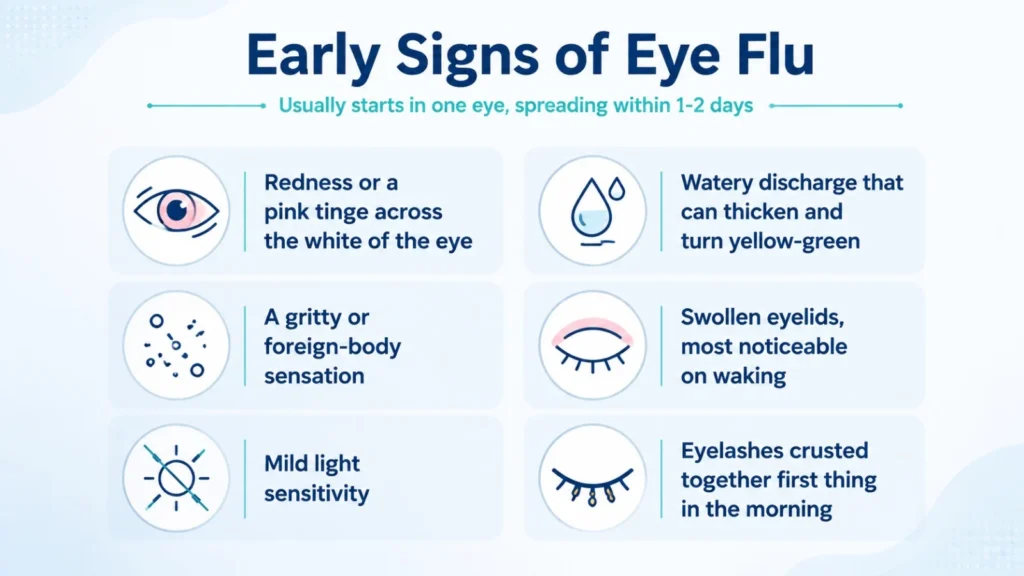
Eye flu usually starts in one eye before spreading to the other within a day or two. Early signs include:
- Redness or a pink tinge across the white of the eye
- Watery discharge that can thicken and turn yellow-green if bacteria join in
- A gritty or foreign-body sensation
- Swollen eyelids, most noticeable on waking
- Mild light sensitivity
- Eyelashes crusted together first thing in the morning
“Patients often describe it as feeling like there’s sand under the eyelid that won’t go away,” says Dr. Kashish Gupta, Director of Ophthalmology at Max Hospital. “Combined with morning crusting, that’s usually enough for us to confirm it’s viral conjunctivitis without needing extensive testing.”
Eye flu usually starts in one eye before spreading to the other within a day or two. Early signs include:
- Redness or a pink tinge across the white of the eye
- Watery discharge that can thicken and turn yellow-green if bacteria join in
- A gritty or foreign-body sensation
- Swollen eyelids, most noticeable on waking
- Mild light sensitivity
- Eyelashes crusted together first thing in the morning
“Patients often describe it as feeling like there’s sand under the eyelid that won’t go away,” says Dr. Kashish Gupta, Director of Ophthalmology at Max Hospital. “Combined with morning crusting, that’s usually enough for us to confirm it’s viral conjunctivitis without needing extensive testing.”
Fast Relief in the First 48 Hours
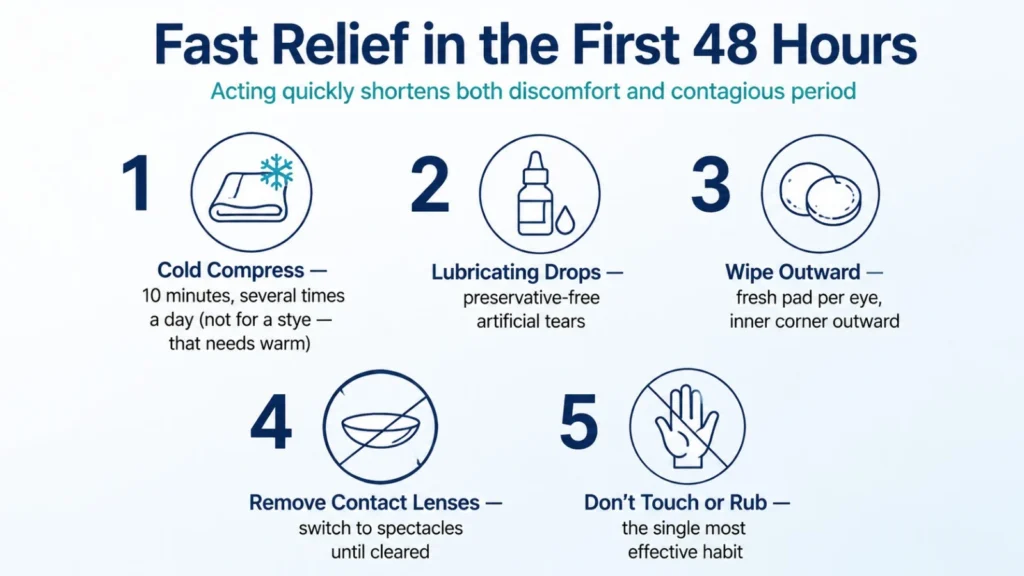
Acting quickly in the first two days shortens both the discomfort and the contagious period:
- Cold compress. A clean, cool (not icy) cloth pressed gently on closed eyelids for 10 minutes, several times a day, reduces swelling fast. Save warm compresses for a stye instead — using the wrong one is a common mix-up.
- Lubricating drops. Preservative-free artificial tears, available without prescription at any Bathinda pharmacy, flush out irritants and ease the gritty sensation.
- Wipe outward, fresh pad each time. Use a clean cotton pad per eye, wiping from the inner corner outward, and never reuse the same pad on both eyes.
- Remove contact lenses immediately. Switch to spectacles until the infection has cleared and a specialist confirms it’s safe to resume.
- Don’t touch or rub the eyes. The single hardest habit to maintain, and the single most effective one for limiting how far and how long the infection spreads.
“The biggest mistake I see is patients self-medicating with whatever antibiotic drop is available at the counter,” Dr. Kashish Gupta notes. “A viral infection doesn’t respond to antibiotics, and the wrong steroid-combination drop can genuinely make things worse. A same-day consultation avoids that guesswork entirely.”
Monsoon Prevention Checklist for Households in Punjab & Elsewhere
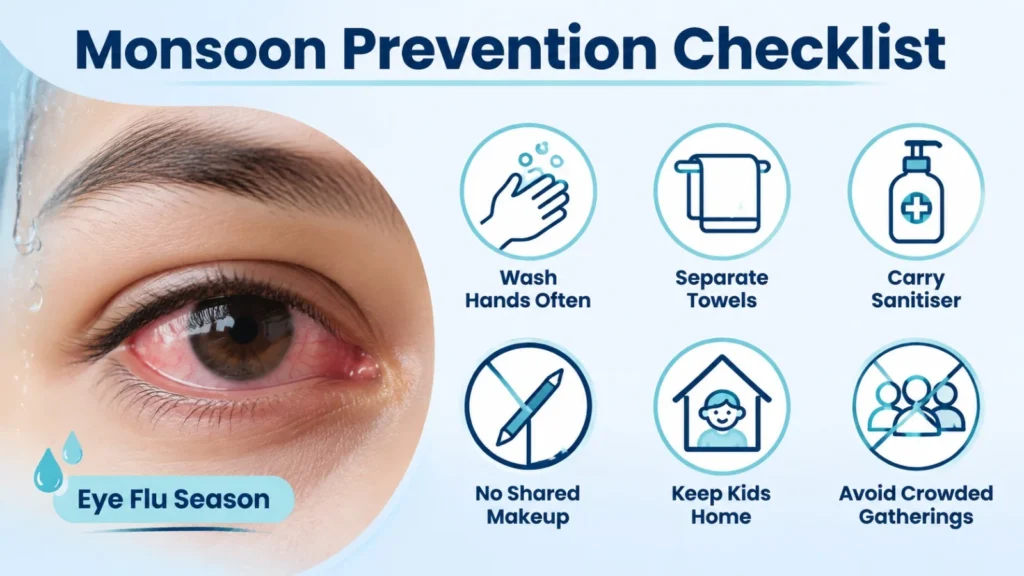
Small, consistent habits go a long way toward keeping eye flu out of your home this season:
- Wash hands thoroughly and often, especially after commuting or handling cash at the mandi
- Keep separate towels and pillowcases for anyone showing symptoms and wash them in hot water daily
- Carry hand sanitiser if you’re regularly crossing waterlogged stretches
- Pause eye makeup entirely during an active outbreak, and never share kajal or eyeliner
- Keep symptomatic children home from school for the first contagious days
- Avoid crowded indoor gatherings — melas, weddings, packed community halls — during a known local outbreak
- Don’t share spectacles, sunglasses, or phones face-down on shared surfaces
Children, the elderly, contact lens wearers, diabetics, and anyone recently operated on should treat these habits as non-negotiable, not optional—their eyes take longer to recover from any inflammation, viral or otherwise.
Eye Flu, Stye or Keratitis? Know the Difference
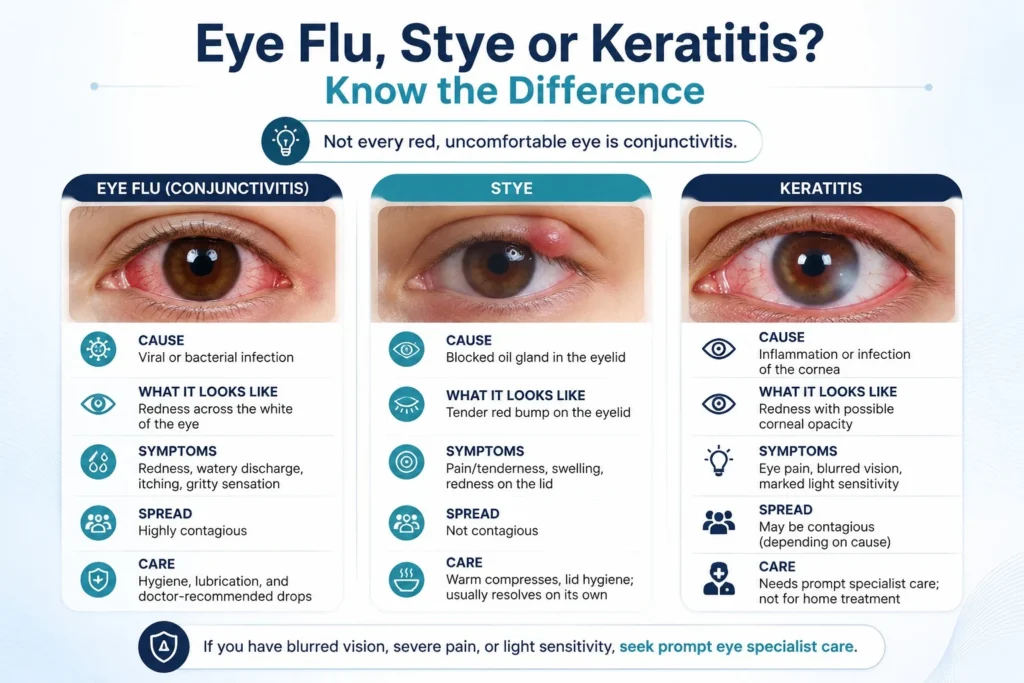
Not every red, uncomfortable eye is conjunctivitis. A stye is a tender bump on the eyelid from a blocked oil gland, and unlike eye flu, it actually responds well to a warm compress. Keratitis — inflammation of the cornea — can cause blurred vision and marked light sensitivity and needs prompt specialist care rather than home treatment, since untreated corneal involvement carries a real risk to vision.
When to See a Specialist — And Why 360° Eye Care Matters
Most eye flu clears up within a week of consistent home care. See a specialist without delay if pain goes beyond mild irritation, vision changes or blurs, discharge stays thick and recurring, symptoms last beyond seven days, or there’s any sign the cornea is affected.
This is also where the value of a full-spectrum eye department becomes clear. Eye flu might be the everyday concern that brings a family through the door, but the same Eye Department at Max Hospital handles the complete range of eye care — from a simple eye infection needing nothing more than the right drop or injection, right through to advanced procedures like LASIK and SMILE laser vision correction, robotic and Femto cataract surgery, ICL implants, retina and glaucoma management, oculoplasty, and treatment for eye tumours and cancers. Having that entire spectrum under one roof means a routine monsoon check-up can, if needed, seamlessly become a conversation about long-term eye health — without a referral to another city.
Meet Dr. Kashish Gupta — Director, Ophthalmology, Max Hospital Bathinda
Dr. Kashish Gupta leads the Eye Department at Max Hospital, Bathinda, with over 20 years of clinical and surgical experience. He completed an advanced fellowship in refractive and robotic cataract surgery at the Singapore National Eye Centre (SNEC), and was honoured with the Sushruta 2025 Award by Max Healthcare, recognising him among the country’s leading eye surgeons. His clinical focus spans cataract and refractive surgery, but his day-to-day practice — like this monsoon guide — is equally grounded in the everyday eye concerns that bring most patients through the door.
Dr. Gupta maintains one of the most active patient-education presences among eye specialists in the region. His YouTube channel carries a large library of videos explaining everything from cataract lens options to laser vision correction, in Punjabi, Hindi, and English. He also shares regular eye-care tips on Instagram and posts department updates on Facebook. For a deeper look at his background and the full range of treatments he offers, his website at drkashishgupta.com is the most complete resource, including a dedicated page on his cataract surgery expertise.
Why the Malwa Region Trusts Max Hospital's Eye Department
Patients travel to Max Hospital’s Eye Department from across the Malwa belt — Bathinda, Mansa, Muktsar, Faridkot, Moga, Barnala, Sangrur, and Ferozepur — for the same reason: a single, technologically current department that covers everything from urgent monsoon eye care to the most advanced vision-correction procedures available in the region. Under Dr. Kashish Gupta’s leadership, the department has built a reputation as one of the most consistently recommended destinations for anyone searching for a trusted eye specialist in Bathinda, whether the need is a same-day eye flu consultation or a long-planned cataract or LASIK procedure.
The Takeaway this Monsoon!
Eye flu is uncomfortable and spreads fast, but for most people, it resolves fully with prompt, sensible care — cold compresses, lubricating drops, clean hands, and a firm rule against touching the eyes. Don’t wait out symptoms that aren’t easing within a few days, and don’t guess with over-the-counter antibiotic drops. A short specialist visit offers real peace of mind, and at Max Hospital, it also means access to a full eye-care team if anything more than a routine infection is ever involved.
Frequently Asked Questions
Yes. Cases rise through July and August as humidity, waterlogging, and crowded market and transit areas all increase how easily the virus spreads.
Simple eye flu is typically managed with drops and home care, not injections. Eye injections are usually reserved for other conditions, such as certain retinal diseases, and should only be given on a specialist’s advice.
No — any active eye infection, including eye flu, needs to fully clear before a LASIK or laser vision correction evaluation. Your specialist will confirm when your eyes are ready.
Home care is usually sufficient for the first few days. A specialist visit is recommended if symptoms don’t improve within a week, if vision changes, or if you fall into a higher-risk group like the elderly, diabetics, or recent surgery patients.
Contact lenses don’t cause eye flu, but they can trap irritants against the eye and worsen symptoms if not removed promptly at the first sign of infection.
Yes. The department is built around 360-degree eye care, covering everyday concerns like eye flu alongside advanced procedures such as LASIK, robotic cataract surgery, and treatment for retina, glaucoma, and oculoplastic conditions.
It’s rarely dangerous, but highly contagious in classroom settings, so keeping a symptomatic child home for the first few days is strongly advised.
It can, and any redness or discharge in a recently operated eye should be reviewed promptly rather than treated as routine eye flu at home.
Patients across Bathinda and the wider Malwa region frequently look to specialists who combine everyday eye-care experience with advanced surgical training — a combination reflected in Dr. Kashish Gupta’s background, including his SNEC Singapore fellowship and Sushruta 2025 Award recognition.
