
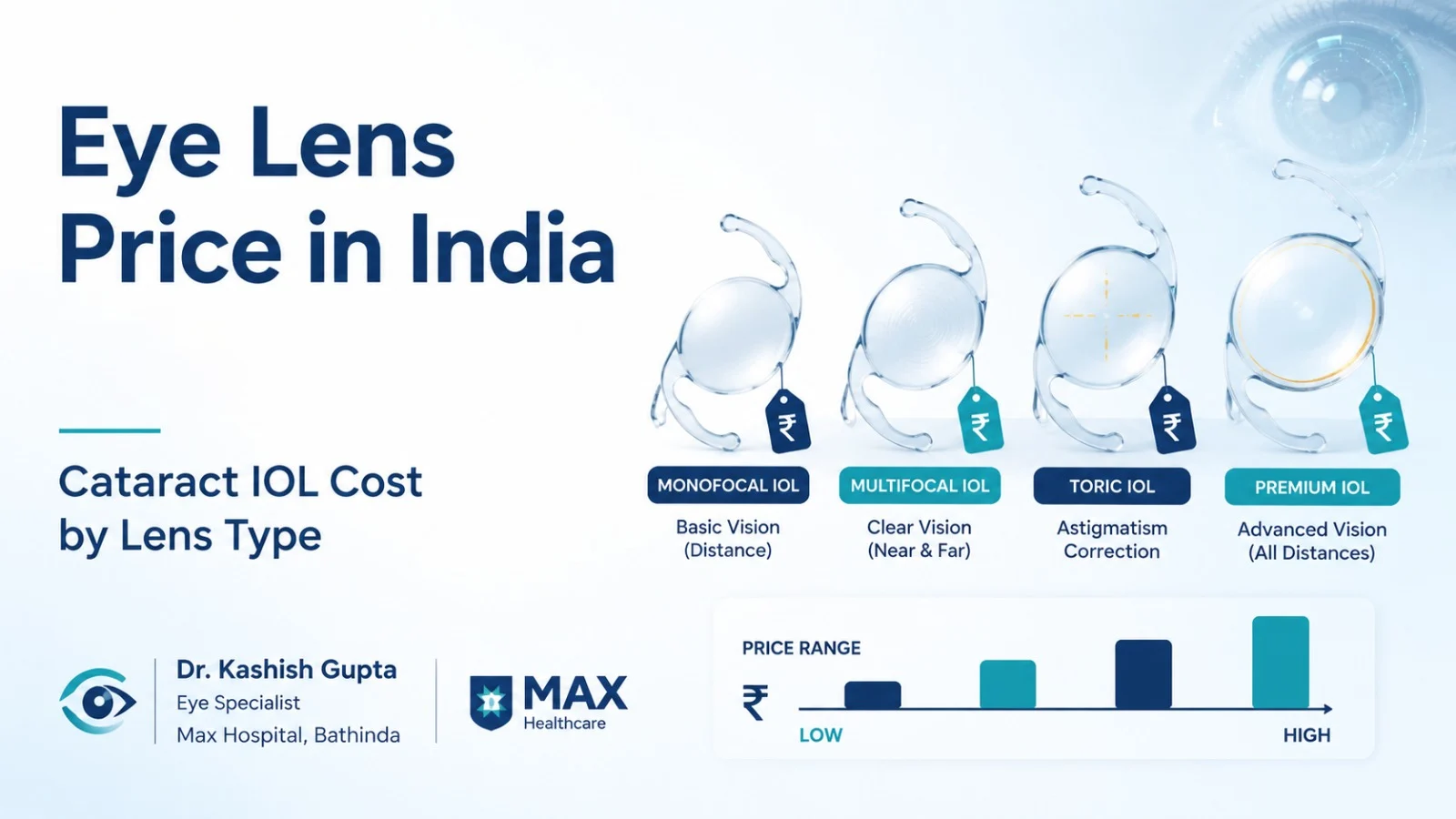
Cataract is generally an age-induced clouding of your natural lens — known in Hindi and Punjabi as Motiyabind or Safed Motia (“white pearl”). As we age past our 50s, we may experience blurry vision, which can progress further if left untreated. Cataracts are a leading cause of blindness worldwide. If you or a family member has been diagnosed with cataract and advised surgery to replace the naturally clouded lens with an artificial clear lens (IOL), one of the first practical questions is usually: how much does the eye lens cost, and what decides the price?
The short answer: the artificial lens used in cataract surgery — called an intraocular lens (IOL) — typically costs somewhere between roughly ₹10,000 and ₹1,30,000 per eye in India, depending mainly on the type of lens. That is a wide range on purpose, because “eye lens price” can mean several different things: the lens alone, the lens plus surgery, or a complete package including tests and hospital charges. Understanding which one you’re actually being quoted is often more useful than the number itself.
This guide breaks down eye lens (IOL) price by lens type, explains what actually drives the cost, and covers what patients in Bathinda, Punjab and the wider Malwa region should know before getting an evaluation.
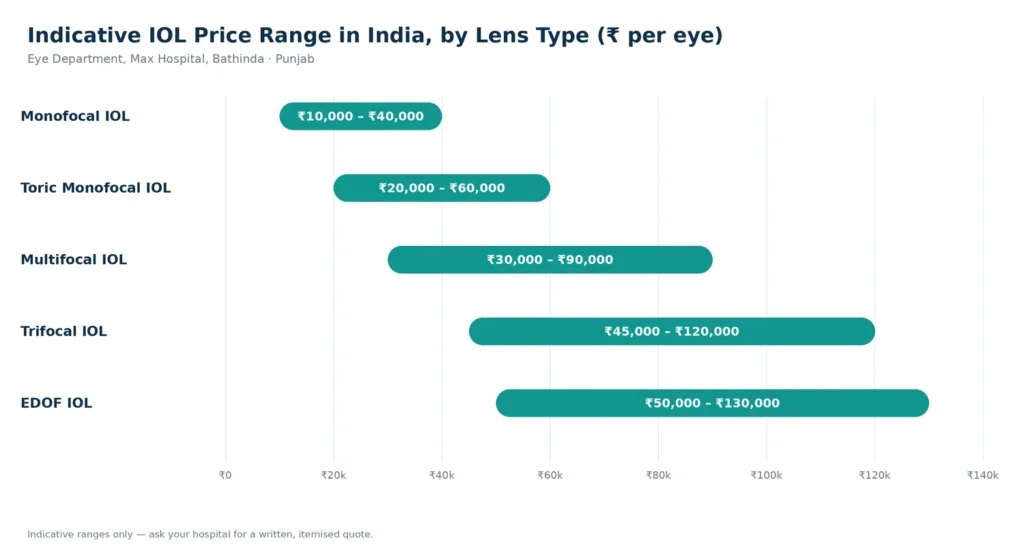
Eye Lens Price in Punjab, India at a Glance
| Lens Type | Indicative Price Range (Per Eye) | Best Suited For |
|---|---|---|
| Monofocal IOL | ₹10,000 – ₹40,000 | Budget-conscious patients comfortable using reading glasses afterward |
| Toric Monofocal IOL | ₹20,000 – ₹60,000 | Patients with significant corneal astigmatism |
| Multifocal IOL | ₹30,000 – ₹90,000 | Patients wanting reduced dependence on glasses for near and distance |
| Trifocal IOL | ₹45,000 – ₹1,20,000 | Patients wanting near, intermediate, and distance coverage |
| EDOF IOL | ₹50,000 – ₹1,30,000 | Patients prioritizing smooth, continuous vision with fewer light-related side effects |
IOL price ranges vary by brand, hospital, city, and the specific lens model recommended after your eye examination. Prices are indicative only — ask your hospital for a written, itemized quote for the lens that suits your needs.
Lens-Only Price vs Cataract Surgery Cost
The number you see quoted in the table above is the lens price alone — not the full cost of cataract surgery. Here is what each type of quote typically covers:
| Quote Type | What’s Included | What’s Usually Excluded |
|---|---|---|
| Lens-only price | The IOL itself | Surgeon fee, OT charges, tests, follow-up |
| Complete surgery package | IOL + surgeon & OT charges + pre-op tests & biometry + anaesthesia & consumables + post-op follow-up & medication | — |
Two patients choosing the “same” lens can be quoted very different totals simply because one figure is lens-only and the other is a full surgery package. As a patient, always ask which one you are looking at.
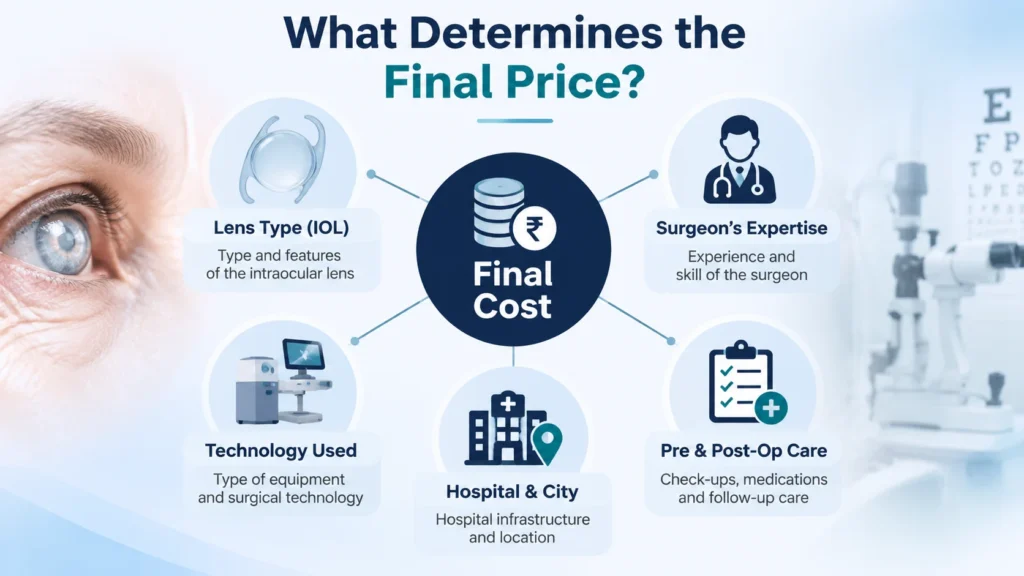
What Determines the Final Price of Your Cataract Surgery?
- Type and technology of the IOL
- Brand and country of manufacture (imported lenses generally cost more than Indian-made ones)
- Whether astigmatism correction is needed
- Surgical technique used
- Diagnostic testing required before surgery
- Hospital location and facilities
- What is included in the quoted amount
What Is an Eye Lens?
What Is an Intraocular Lens (IOL)?
Inside the eye sits a natural, transparent lens that focuses light onto the retina, similar to a camera lens. In cataract, this natural lens gradually turns cloudy, causing blurred vision. During cataract surgery, the surgeon removes the cloudy natural lens and replaces it with a clear artificial lens — the intraocular lens (IOL). This replacement lens stays in the eye permanently.
Why Is an IOL Used in Cataract Surgery?
Cataract surgery is not possible without replacing the removed natural lens with something that can perform its focusing function. The IOL is what allows the eye to focus light again after the cloudy lens is removed. The type of IOL selected can influence how much a patient depends on glasses afterward for different distances — though the exact outcome varies from person to person and depends on individual eye measurements and health, not the lens alone.
How Long Does an Artificial Lens Last?
IOLs are designed to remain functional for a patient’s lifetime in the vast majority of cases and generally do not need to be replaced or “worn out” the way natural lenses do.
Types of Eye Lenses and Their Prices
Monofocal IOL
Indicative range: ₹10,000 – ₹40,000 per eye
The most commonly used and generally most affordable IOL. It focuses clearly at one distance, usually set for distance vision (driving, watching TV). Reading, phone use, or close work will typically still need glasses afterward.
May be a reasonable option for patients who:
- Are comfortable using reading glasses after surgery
- Have budget constraints
- Do not have significant astigmatism
Toric Monofocal IOL (Price range: ₹20,000 – ₹60,000 per eye)
Designed for patients with astigmatism — where the cornea’s irregular curvature causes blurred or distorted vision at all distances. A standard monofocal lens does not correct this cylindrical power; a toric lens is built specifically to address it. Whether a toric lens is appropriate depends on the degree of astigmatism found during your eye examination.
Multifocal IOL (Price range: ₹30,000 – ₹90,000 per eye)
Built with multiple focusing zones so the eye can focus at more than one distance — near and far — without switching glasses for every task. This can reduce, though not always eliminate, the need for glasses in daily activities like using a phone, reading, or driving.
Multifocal lenses may involve trade-offs for some patients, including glare or halos around lights, particularly at night. Clinical studies comparing multifocal and monofocal outcomes have generally found that while multifocal IOLs improve near-vision independence, overall patient-reported outcomes between the two can be closer than expected — which is why the choice should be based on individual priorities and eye examination findings, not price or marketing alone.
Trifocal IOL (Price range: ₹45,000 – ₹1,20,000 per eye)
An advanced version of the multifocal lens with three focusing ranges — near (reading), intermediate (computer/laptop distance), and far (driving, TV). This is intended to give a more continuous, natural range of vision, which some patients — particularly those who spend a lot of time on screens — find useful. As with multifocal lenses, glare and halo effects are possible and vary by individual.
EDOF IOL — Extended Depth of Focus (Price range: ₹50,000 – ₹1,30,000 per eye)
A newer lens category designed to produce a smooth, extended range of focus rather than distinct focal “steps.” The intent is to reduce the sharp jumps between focus zones seen in some multifocal designs, and in some patients, this is associated with fewer glare or halo symptoms than multifocal or trifocal lenses. It does not guarantee glasses-free vision at every distance, and near-vision performance can be more limited than with trifocal lenses for some patients — your ophthalmologist can assess whether this trade-off suits your visual goals.
Eye Lens Price by Brand
Brand pricing for IOLs varies significantly by manufacturer, whether the lens is imported or Indian-made, and by hospital procurement — so much so that fixed brand-wise prices can become inaccurate within months. Rather than quote figures that may not reflect current pricing, we recommend asking your treating hospital directly which specific brand and model is being proposed, and requesting the price in writing as part of your evaluation.
What Factors Affect Eye Lens Price in India?
- IOL Type — monofocal, toric, multifocal, trifocal, or EDOF
- Lens Technology — aspheric design, blue-light filtering, aberration correction
- Brand — imported lenses are typically priced higher than Indian-manufactured lenses
- Astigmatism Correction — toric versions of any lens type cost more than their non-toric equivalent
- Surgical Technique — standard phacoemulsification vs. laser-assisted (FLACS) or robotic-assisted approaches
- Diagnostic Testing — biometry and other pre-surgical measurements
- Hospital and Location — city, hospital tier, and facilities
- What Is Included in the Quote — lens only vs. full surgical package
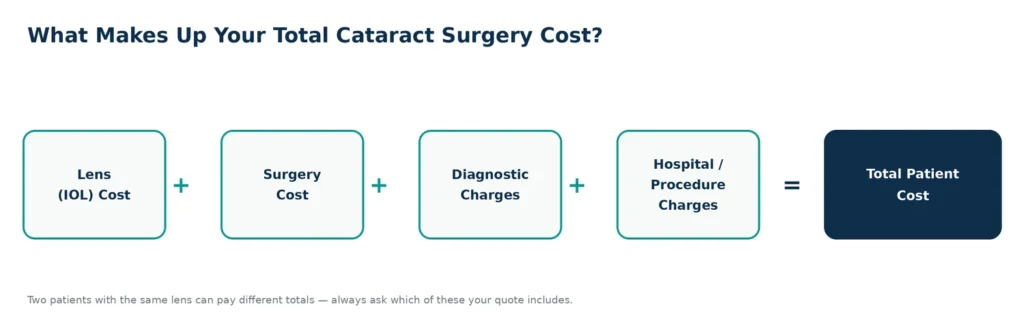
Eye Lens Price vs Cataract Surgery Cost
| Component | What It Covers |
|---|---|
| Lens Cost | The IOL itself, priced by type and brand |
| Surgery Cost | Surgeon’s fee, OT charges, anaesthesia, consumables |
| Diagnostic Charges | Pre-operative eye measurements and tests |
| Hospital / Procedure Charges | Facility fees, day-care or admission charges |
Prices differ between patients not because of arbitrary markups, but because each patient’s lens choice, eye measurements, surgical technique, and hospital package genuinely differ. Two patients with the same diagnosis can have different total costs for legitimate clinical reasons.
Eye Lens Price in Bathinda, Punjab: What Patients Should Know
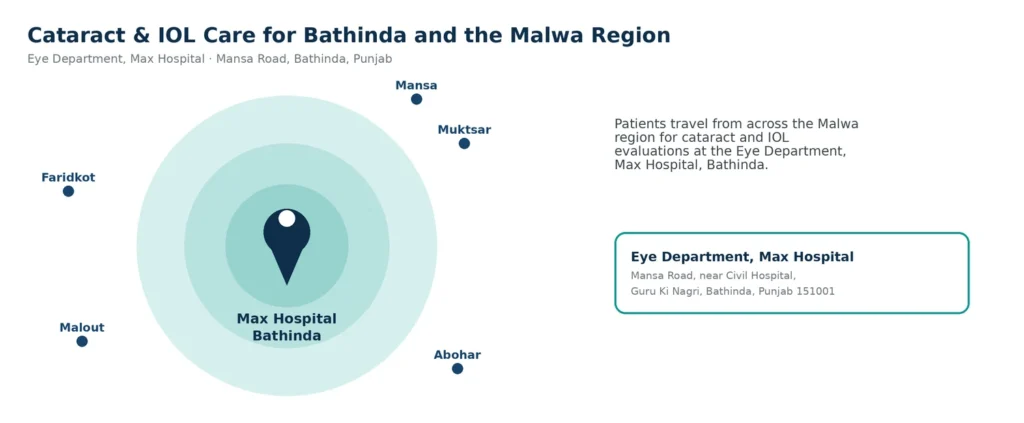
If you are researching this from Bathinda or the surrounding Malwa region (Mansa, Muktsar, Faridkot, or nearby areas), the same national principles apply locally — but a few things are worth knowing specifically.
Why Cataract Lens Prices Can Vary in Bathinda, Punjab
As with anywhere in India, the price depends on the lens type chosen, whether the quote is lens-only or a full surgical package, and the specific technology used. A quote from one hospital cannot be assumed to match another, even for the “same” lens category — always ask for a written breakdown.
Lens Price vs Complete Cataract Surgery Package
When comparing quotes locally, confirm whether the figure you have been given includes the surgeon’s fee, OT charges, and diagnostic tests, or only the lens itself. This is the single most common source of confusion in cataract-cost conversations.
Choosing an IOL Based on Your Eyes, Not Just Price
The most suitable lens depends on your eye measurements, general eye health, lifestyle, and visual priorities — not simply which option is cheapest or most expensive. This is why an in-person eye examination generally comes before, not after, a final price is confirmed.
Where to Get an IOL Evaluation in Bathinda
The Eye Department at Max Hospital, Mansa Road, Bathinda, led by Dr. Kashish Gupta, provides cataract and IOL evaluations for patients from Bathinda and nearby areas of the Malwa region. An evaluation typically includes an eye examination and biometric measurement to determine which lens options are appropriate for your eyes before any price is finalised.
Which Eye Lens May Suit Different Vision Goals?
General guidance only — final suitability depends on an eye examination.
If distance vision is your main priority: A monofocal lens set for distance is often sufficient, with reading glasses used for near tasks.
If reducing reading-glasses dependence matters to you: Multifocal, trifocal, or EDOF lenses may be discussed with your ophthalmologist.
If you have astigmatism: A toric version of your chosen lens type may be recommended.
If you need intermediate (computer-distance) vision: Trifocal or EDOF lenses are designed with this range in mind.
If you drive frequently, including at night: Your ophthalmologist may weigh glare/halo risk against near-vision benefit when discussing multifocal, trifocal, or EDOF options.
If you use screens frequently through the day: Intermediate-distance coverage (trifocal/EDOF) may be a relevant discussion point.
If budget is a major consideration: A monofocal lens remains the most affordable option, with the trade-off of continued glasses use for near tasks.
In every case, the final decision should follow a proper eye examination by your eye specialist — not this checklist alone.
Monofocal vs Multifocal vs Toric vs EDOF
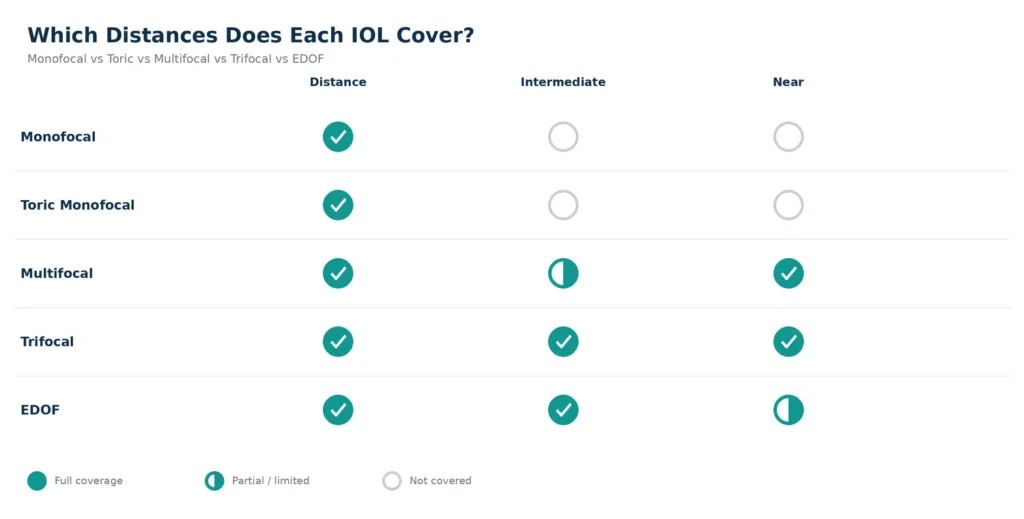
| IOL | Main Purpose | Dist. | Interm. | Near | Astig. | Glasses Dependence | Cost | Key Consideration |
|---|---|---|---|---|---|---|---|---|
| Monofocal | Single-distance focus | Yes | No | No | No | Higher (near) | Lowest | Most affordable, well-established |
| Toric Monofocal | Astigmatism correction + single distance | Yes | No | No | Yes | Higher (near) | Moderate | For meaningful astigmatism |
| Multifocal | Near + distance | Yes | Limited | Yes | No* | Lower | Mod–High | Possible glare/halo trade-off |
| Trifocal | Near + intermediate + distance | Yes | Yes | Yes | No* | Lowest | High | Broadest range; side-effect variability |
| EDOF | Extended, continuous focus | Yes | Yes | Limited | No* | Low–Moderate | High | Often fewer glare/halo symptoms |
Are Premium Eye Lenses Worth the Extra Cost?
What Makes an IOL “Premium”?
Generally, lenses beyond standard monofocal — multifocal, trifocal, EDOF, and toric versions of any of these — are referred to as premium IOLs, reflecting more advanced optical design intended to reduce dependence on glasses.
Potential Benefits
Reduced reliance on glasses for some or most daily activities, in appropriately selected patients.
Possible Trade-Offs
Higher cost, possible glare or halos (particularly at night), and outcomes that vary between individuals — a premium lens does not guarantee a specific visual result for every patient.
Why More Expensive Does Not Always Mean Better for Every Patient
Clinical comparisons between premium and standard IOLs have found that reported patient satisfaction and overall outcomes can be closer between categories than price differences would suggest. The right lens is the one that matches your eyes, lifestyle, and expectations — not necessarily the most expensive one available.
How to Choose an IOL Before Cataract Surgery
- Eye Examination — assessment of overall eye health and cataract severity
- Biometry — precise measurement of the eye to calculate the correct lens power
- Ocular Health — checking for other conditions (e.g., retinal issues) that may affect which lens is suitable
- Lifestyle — driving habits, screen use, hobbies
- Visual Expectations — how much you are willing to trade cost or potential side effects for reduced glasses dependence
- Discussion With Your Ophthalmologist — final decision made jointly, based on the above
Why IOL Selection Is Important in Cataract Surgery
Cataract surgery itself typically takes a short time, but the lens implanted remains in the eye long-term. The choice connects directly to daily visual experience afterward — how much glasses are needed, how driving at night feels, how comfortable extended reading or screen use is. This is why the decision is based on your eye measurements and visual goals rather than price alone, and why it is discussed with your ophthalmologist rather than decided in advance of an examination.
Frequently Asked Questions About Eye Lens Price
Depending on the type, IOL prices in India generally range from roughly ₹10,000 to ₹1,30,000 per eye. The exact figure depends on lens type, brand, and hospital.
Typically the most affordable option, generally in the lower part of the overall price range.
Multifocal lenses are priced higher than monofocal lenses, reflecting their additional focusing technology.
Toric versions of a lens type typically cost more than the non-toric equivalent, due to the added astigmatism-correcting design.
EDOF lenses are generally among the higher-priced categories, similar to or above trifocal lenses depending on brand.
Not always — some quotes are lens-only, others are full packages including surgeon fees, OT charges, and tests. Always confirm which one you are being quoted.
A standard monofocal lens is generally the most affordable option, though it typically requires glasses for near tasks afterward.
There isn’t a single “best” lens for everyone — the right choice depends on your eye measurements, health, lifestyle, and visual priorities, determined through an eye examination.
IOLs are generally designed to last a patient’s lifetime without needing replacement.
Total cost depends on the lens type chosen and whether the quote includes surgery, diagnostics, and hospital charges. Contact the Eye Department at Max Hospital, Bathinda for an itemised estimate based on your specific evaluation.
Motiyabind (also called Safed Motia, meaning “white pearl”) is the common Hindi and Punjabi term for cataract — the clouding of the eye’s natural lens. It is the same condition described throughout this guide, and it is treated through cataract surgery with IOL (artificial lens) implantation.
Cataract and IOL Consultation in Bathinda
Dr. Kashish Gupta leads the advanced Eye Department at Max Hospital, Bathinda, with experience in cataract and IOL surgery, including robotic-assisted techniques. Patients from Bathinda and nearby areas of the Malwa region can get a cataract and IOL evaluation here, which typically includes an eye examination and biometric measurements to establish which lens options are suitable before finalising a price.
If you are comparing cataract lens options or prices, an eye examination is the best starting point. A cataract specialist can assess your eye measurements, discuss your visual priorities, and explain which IOL options are appropriate for you.
For an evaluation or itemised quote, contact:
Helpline: 98770 45152
Eye Department, Max Hospital, Mansa Road, near Civil Hospital, Guru Ki Nagri, Bathinda, Punjab 151001
Eye Doctor's Review
This article is medically reviewed by Dr. Kashish Gupta — Director of Ophthalmology, Max Hospital, Bathinda.
